
Full Mouth Rehabilitation: Who Needs It & What to Expect
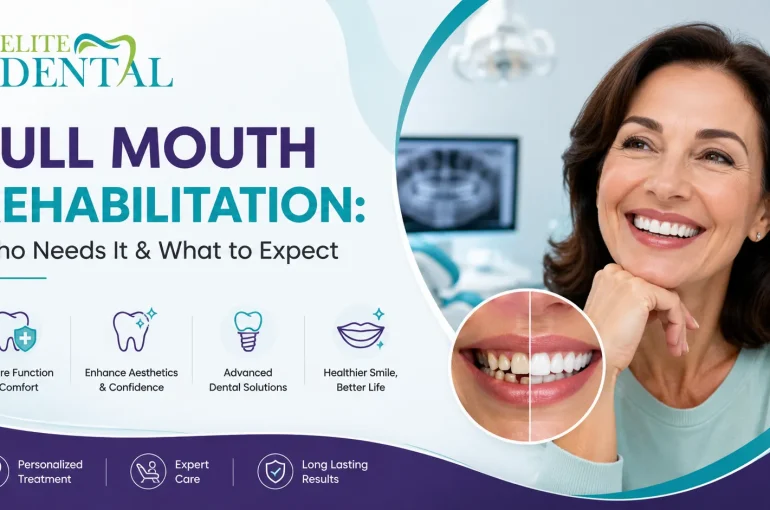
Losing multiple teeth or living with severely damaged ones affects far more than your appearance. It impacts how you eat, speak, and feel about yourself every single day. Full mouth dental implants offer a permanent, natural-looking solution that restores both function and confidence. Whether you are missing most of your teeth or dealing with failing dentition, this treatment can transform your quality of life.
This guide explains who qualifies for full mouth dental implants, the different implant systems available, what the treatment journey involves, and what to realistically expect before, during and after.
Full Mouth Dental Implants: Understanding Full Mouth Rehabilitation
Full mouth rehabilitation, also called full mouth reconstruction, is a comprehensive dental treatment plan designed to restore or replace all or most of the teeth in the upper and lower jaw. Full mouth dental implants are the gold standard approach within this treatment category.
Unlike dentures that rest on the gums and can shift or slip, implant-based rehabilitation anchors the new teeth permanently into the jawbone using titanium implant posts. The result closely mimics natural teeth in both look and function.
Full mouth rehabilitation is typically recommended when:
- Most or all teeth are missing due to decay, gum disease, or injury
- Remaining teeth are severely compromised and cannot be saved
- Existing dentures are unstable, uncomfortable, or ill-fitting
- There is significant bone loss that has altered the facial structure
- Multiple teeth have failed due to untreated infections or trauma over time
All-on-4 Dental Implants: Full Arch Restoration on Four Posts
All-on-4 dental implants is a technique where a complete arch of teeth, upper or lower, is supported by just four strategically placed implant posts. Two implants are placed vertically at the front of the jaw, and two are angled towards the back at approximately 45 degrees.
This angulation allows the implants to make use of denser bone at the front of the jaw, often avoiding the need for bone grafting even in patients with moderate bone loss.
Key Features of All-on-4
- Implants required: Four per arch (upper or lower jaw)
- Bone grafting: Often not required due to the angled posterior implants
- Loading: Temporary fixed teeth can often be placed on the same day as implant surgery
- Best suited for: Patients with moderate bone loss seeking a faster, less invasive full-arch solution
- Longevity: With good oral hygiene, All-on-4 restorations can last 20 years or more
All-on-4 dental implants have a strong global track record. Clinical studies report long-term survival rates of over 94% for this implant system, making it one of the most reliable full-arch solutions available.
All-on-6 Dental Implants: Greater Stability for Complex Cases
All-on-6 dental implants follow the same principle as All-on-4 but use six implants per arch instead of four. The two additional implants provide greater load distribution, particularly beneficial for patients with stronger bite forces or more advanced bone loss.
Key Features of All-on-6
- Implants required: Six per arch
- Stability: Superior distribution of bite load across a wider implant base
- Bone grafting: May be required in areas of significant bone volume loss
- Best suited for: Patients who require maximum stability, those with higher bite forces, or cases where additional support is clinically advisable
- Longevity: Comparable to All-on-4 with proper care, designed as a permanent, lifetime solution
Your implant specialist will assess your bone density, jaw structure, and clinical needs to determine whether All-on-4 dental implants or All-on-6 dental implants is the more appropriate choice for your specific case.
Full Mouth Dental Implants: Candidacy Criteria
Understanding what the journey involves helps patients plan realistically. Here is a general overview of the stages involved:
Stage 1: Comprehensive Assessment
The process begins with a full clinical examination, including digital X-rays, CBCT (3D cone beam) scans, gum assessment, and a review of medical history. This maps out the jaw structure in precise detail and guides the treatment plan.
Stage 2: Preparatory Treatments
If required, preparatory procedures like extractions of remaining teeth, bone grafting, or gum disease treatment are completed first. Healing time after bone grafting typically ranges from 3 to 6 months.
Stage 3: Implant Placement Surgery
The implant posts are surgically placed into the jawbone under local anaesthesia. With computer-guided implant systems, the procedure is more precise and less invasive than traditional approaches.
Stage 4: Healing and Osseointegration
Over the next 3 to 6 months, the titanium implants fuse with the jawbone through a natural process called osseointegration. This forms the stable, permanent anchor for the final prosthesis.
Stage 5: Final Prosthesis Placement
Once osseointegration is confirmed, the final full-arch prosthesis, typically a ceramic or zirconia bridge, is fabricated and securely attached to the implant posts. The result is a complete, functional set of permanent teeth.
Full Mouth Dental Implants at Elite Dental Hub, Chandigarh
At Elite Dental Hub in Sector 19A, Chandigarh, full mouth dental implants, including All-on-4 and All-on-6 dental implants, are carried out using computer-guided implant planning for maximum precision and predictability. Every case begins with a detailed 3D scan and an individualised treatment roadmap.
Led by Dr. Swati Narang Kaushik, the team brings extensive experience in complex implant cases and full mouth rehabilitation. Patients receive complete end-to-end care- from initial assessment through to final prosthesis, with transparent communication at every stage.
The clinic’s international-grade sterilisation protocols and patient-first approach make it a trusted choice for those considering full mouth dental implants in Chandigarh.
Ready to Restore Your Smile? Book Your Implant Consultation Today
If you are tired of living with missing teeth or struggling with loose dentures, full mouth dental implants could be the permanent solution you have been looking for. At Elite Dental Hub, our implant team will assess your case, explain your options, and design a treatment plan built around your needs, with no pressure and complete clarity.
Address: House No. 5, Sector 19A, Opposite HDFC Bank, Chandigarh — 160019
Clinic Hours: Monday to Saturday | 10:30 AM – 7:30 PM
Book Online: Book your appointment | Walk-ins welcome
Conclusion
Full mouth dental implants represent one of the most significant advances in modern dentistry. Whether through All-on-4 dental implants or All-on-6 dental implants, patients with extensive tooth loss can regain a fully functional, natural-looking smile that lasts for decades.
The journey requires commitment, professional planning, and the right dental team. But for patients who complete the treatment, the outcome, eating freely, smiling confidently, and speaking clearly, is genuinely life-changing. Start with a consultation and take it one step at a time.
Frequently Asked Questions
Are full mouth dental implants permanent?
How are All-on-4 and All-on-6 dental implants different?
Is the full mouth implant procedure painful?
How long does full mouth dental implant treatment take?
Can I eat normally after getting full mouth dental implants?
What is the success rate of full mouth dental implants?
Search
Categories
Archives
Tags
Recent Posts
- Smile Makeover: What’s Involved & Cost in Chandigarh
- Clear Aligners vs Braces: Cost, Time & How to Choose
- Teeth Whitening at Home vs At the Dentist: What Actually Works?
- Dental Check-Up: What Happens, How Often & Why It Matters
- Teeth Deep Cleaning (Scaling): Process, Cost & Why Teeth Feel Sensitive After

